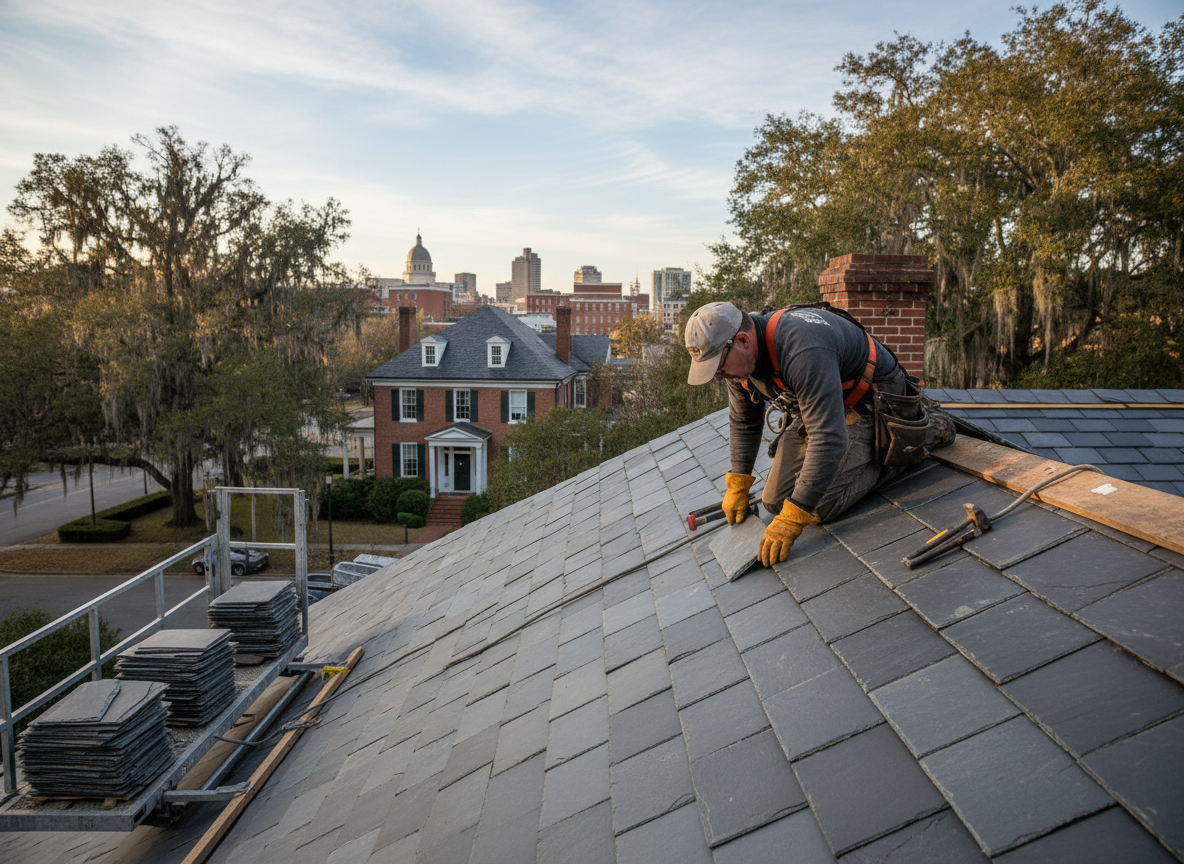
Slate roofs demand careful handling because each tile carries significant weight that older Montgomery homes often were not built to support without reinforcement. When working on properties near the downtown core or along the Alabama River corridor, crews first verify rafter spacing and sheathing condition before any tile is lifted. Natural slate varies in thickness and texture, so matching existing courses requires sorting on site rather than ordering pre-sorted pallets that may not align with the original installation.
Montgomery summers bring intense sun and sudden thunderstorms that can drive water under poorly seated flashings or around chimney crickets. Experienced roofers here pay extra attention to step flashing integration at every wall intersection and use ice-and-water membrane only where code permits on low-slope transitions. Homeowners sometimes attempt to patch individual broken slates with asphalt cement, which traps moisture and accelerates rot in the underlying felt; proper repair instead involves sliding new slate into place with copper tabs so the assembly breathes.
Edge conditions such as ridge vents, solar panel mounts, and gutter tie-ins require custom fabrication because standard aluminum flashings do not match slate expansion rates. Crews also check for hidden layers of previous roofing that add unexpected weight, a common discovery on 1960s and 1970s homes in the Montgomery area. These details determine whether a full tear-off or selective repair is feasible without structural work.
Technician insight
In Montgomery, the thing that catches most people out with Slate roofing is the combination of older rafter spacing and summer humidity that makes underlayment fail faster than the slate itself, especially on homes east of the river where ventilation was never upgraded.
Slate Section Replacement After Storm
A Montgomery homeowner reported interior leaks following heavy rain. Inspection revealed cracked slate and deteriorated felt around a chimney on a 1970s house. Crews removed damaged tiles, replaced the underlayment and step flashing with copper, and reinstalled matching slate. No further leaks occurred after the next rainfall.
How it works
- 1
Site Assessment
Walk the roof and attic to evaluate slate condition, underlayment, and structural support specific to Montgomery construction.
- 2
Material Matching
Sort and grade replacement slate on site to align thickness, color, and texture with the existing roof.
- 3
Flashing and Detail Work
Replace or upgrade step flashing, valleys, and crickets using copper or lead-coated copper suited to local humidity.
- 4
Final Inspection and Cleanup
Check every course for secure nailing, verify drainage, and remove all debris from the property.
Pricing
Upfront quotes follow on-site inspection; total cost reflects roof pitch, access, and whether structural reinforcement is needed.